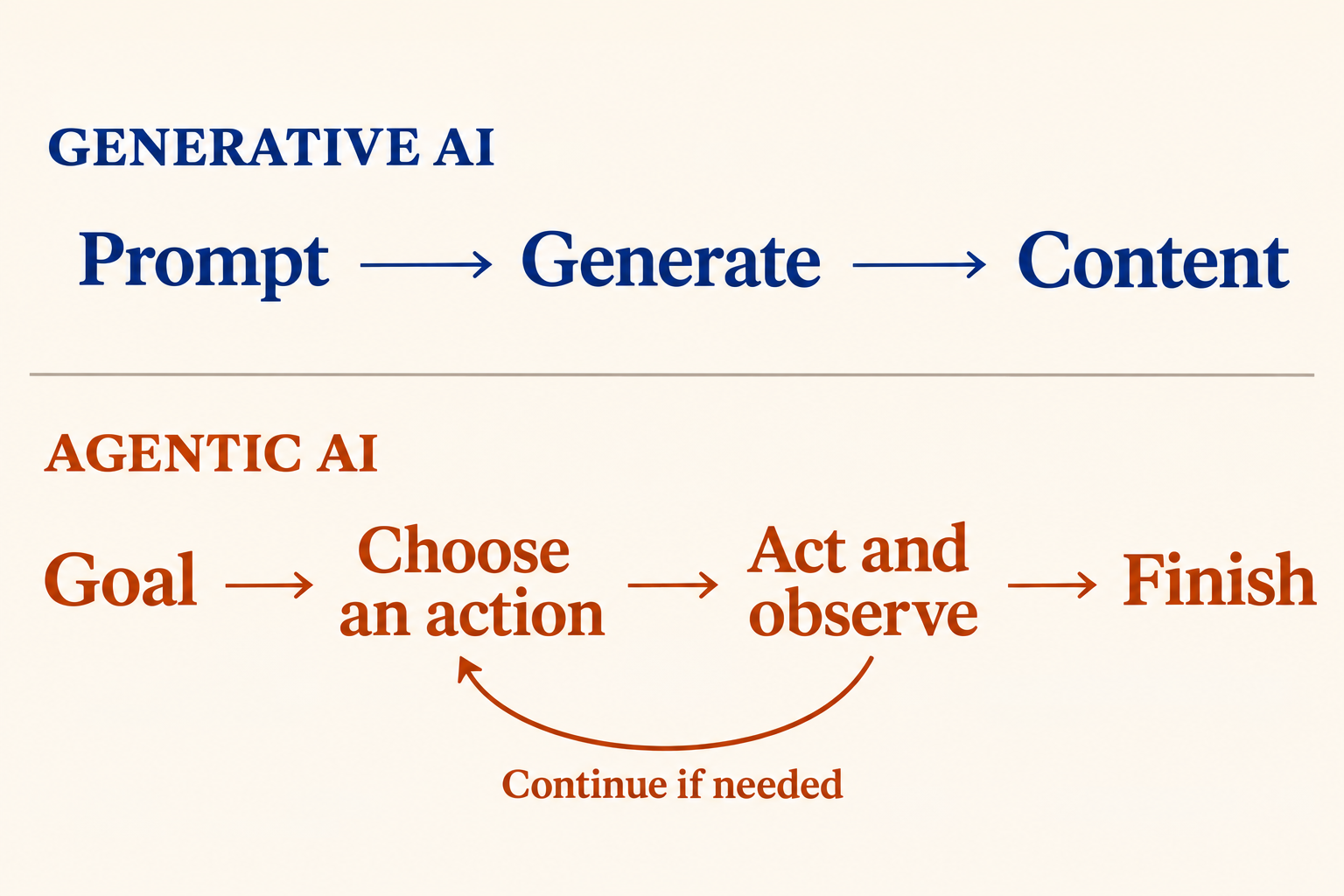
Generative AI produces content. Agentic AI can choose what action to take next. The first term describes a capability such as writing, image generation, or code completion. The second describes how a system works toward a goal and adjusts its actions in response to what happens. A product can do both. A research agent, for instance, can choose which sources to investigate and use a generative model to write up what it finds.
Generative AI and agentic AI side by side
| Question | Generative AI | Agentic AI |
|---|---|---|
| What does the term describe? | The ability to produce or transform content. | A system’s ability to choose and carry out actions toward a goal. |
| What do you give it? | A request, source material, and an idea of the output you want. | A goal, tools it can use, and limits on what it may do. |
| Who chooses the next step? | You or the surrounding software usually direct the next request. | The system can use an intermediate result to decide its next action. |
| What comes back? | An answer, image, audio track, code change, or other content. | A completed action, a result to inspect, or a specific question when it gets stuck. |
| How do you review it? | Read, listen to, or inspect the output against the brief. | Check the outcome and any actions that changed files or records. |
| When is it useful? | Drafting, translation, illustration, and code suggestions. | Research or follow-up work where the next step depends on what turns up. |
What each term tells you
“Generative” describes the kind of output a model can produce. It can write a paragraph, compose audio, create an image, or propose a change to a piece of code. It can also transform work you give it, as in translation, summarization, or rewriting. Whether that output is useful depends on the material you supplied and the requirements the result has to meet. NIST’s generative AI risk profile describes how a model can produce plausible but inaccurate content. A good translation preserves meaning. A good product image shows the correct item. Both judgments can be made by examining the output.
“Agentic” describes how software goes about a task. The system has a goal and some freedom to choose its actions. It may search, inspect a file, compare what came back, and decide to stop or try another source. A finished task can produce a written answer, an updated record, or a request for information it could not find. The choice the system gets to make can be quite narrow. It could have permission to read documents and decide which ones to inspect while every change still requires a person’s approval.
Who decides the next step?
A chat can run for ten turns because you keep giving directions. That is useful collaboration, but the length of the conversation tells you little about the system’s autonomy. Ask what happens when the first answer is incomplete. If you have to spot the gap and tell it exactly where to look next, you are directing the research. If the system recognizes the gap, chooses another source and checks whether the new evidence resolves it, you have delegated part of that decision.
The same question works when a vendor advertises tool access. A search button shows that a product can retrieve information. It does not tell you whether each request triggers one search in a predetermined sequence or whether the system can revise its search after seeing the results. Anthropic’s engineering guide distinguishes predefined workflows from agents that direct their own tool use. It is a practical question to ask about a feature, even when vendors use different terminology.
How the two capabilities fit in one product
An agent can use a generative model to interpret what you want, choose a tool, and write the response. The surrounding software supplies things the model needs to act, such as the tools it can call and access to the results. This is why a generation model may sit inside an agent. The model name tells you something about the engine producing the content. You still need to know which actions the application supports and which ones you have authorized.
Anthropic describes this combination in its account of how Claude Research works. A lead agent plans what to investigate and delegates searches. The sources those searches turn up shape the rest of the investigation. The system also generates a written answer. The search decisions and the writing are distinct parts of one product. A reader who only sees the final prose would have little way to tell how much research happened, which makes links to the underlying sources especially useful.
Where a fixed workflow fits
A scheduled process can collect rows from a known spreadsheet, ask a model to summarize them, and put the result in a shared document. The writing is generative. The person setting up the process chooses the order of operations, a pattern Anthropic calls a predefined workflow. If every run has the same source, format, and destination, that predictability makes it easy to tell which step failed and rerun it. A workflow with several steps can be perfectly adequate for this kind of job.
A fixed workflow can also contain an agent. Consider a research task with a fixed deadline, a fixed report format, and an open question about which evidence to examine. The agent can choose sources and decide whether another search would help. Software can enforce the deadline and deliver the report for approval. When you compare products, identify the decisions that actually vary from one job to the next. Those are the points where giving an agent some discretion may change what it can deliver.
What you check, and what the work costs
For a generated answer, check the answer itself. Does the summary preserve the qualification in the original? Did the translation keep the person’s name and the price intact? For an agent that can change things, check the resulting state as well. If the task was to save a file, open it. If it was to update a record, inspect the record and see which evidence the change relied on. An agent’s message saying the work is complete is one statement you can check against what happened.
Costs follow the work. A long video generation can be expensive on its own. A research agent may make several small model calls, pay for searches, or repeat a step when the first source is unhelpful. If cost matters, compare the time and expense of getting a result you actually accept, including the time you spend checking it. For open-ended work, set a stopping point, such as a limit on searches or an instruction to ask for help when the available sources disagree.
Which one fits your task?
Choose generation when you can name the deliverable and supply its inputs. Translation, copy editing, illustration, and drafting code all fit. If the same request repeats every week, keep the generation step and automate the predictable work around it. A reviewer can judge the content against the source and ask for changes. This is also a good starting point when the final wording or image matters more than the path used to make it.
Choose an agentic workflow when the goal is clear but the route depends on what the system discovers. Research across changing sources and investigating an unresolved support request both have that property. Decide which sources the agent may read, which changes it may make, and when it should come back to you. For a trial, give it a question with a genuinely missing piece of information. What it does at that point tells you more about the responsibility you can delegate than a polished answer to an easy question.
Frequently asked questions
Is agentic AI a more advanced version of generative AI?
The terms describe different capabilities. A strong image model can make an excellent image without having tools to pursue a task. An agent with modest writing ability can still choose and carry out useful actions.
Can the same model support both kinds of work?
Yes. A model may write text in one application and help select and carry out actions in another. The second application needs appropriate tools, instructions, and permissions.
Can a chatbot use agentic AI?
Chat is an interface. The same interface can return a draft, trigger a fixed workflow, or let a system decide which actions to take after inspecting a result.
Does tool use make an AI system agentic?
Tool use is one part of many agentic systems. Look at how the next step is chosen. A fixed search-and-write sequence and a system that adjusts its plan based on results offer different degrees of control.
Does agentic AI need permission to act on its own?
The system can only act through the tools and permissions it has been given. It can decide how to prepare work and still need a person to approve a change or an external action.
When should I use agentic AI?
Consider it when the next step depends on changing inputs or intermediate results and you can define an outcome to check. For a draft, translation, or another content task with a clear input, generation alone is often sufficient.